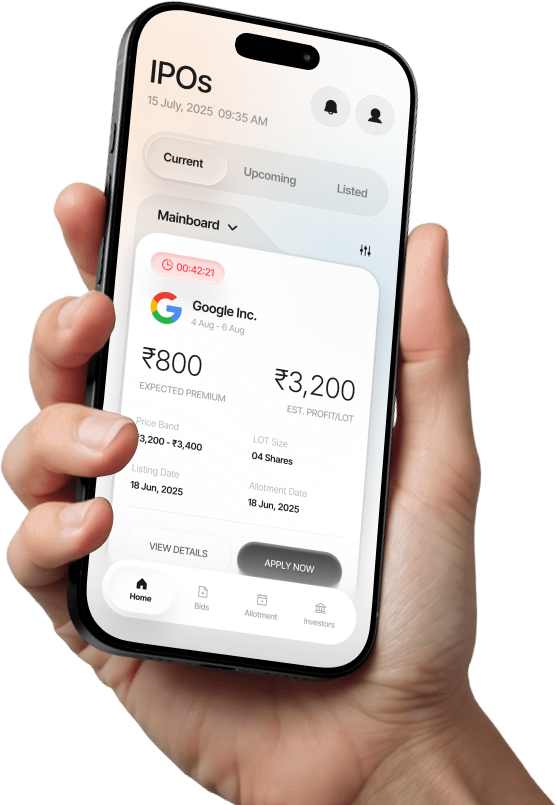
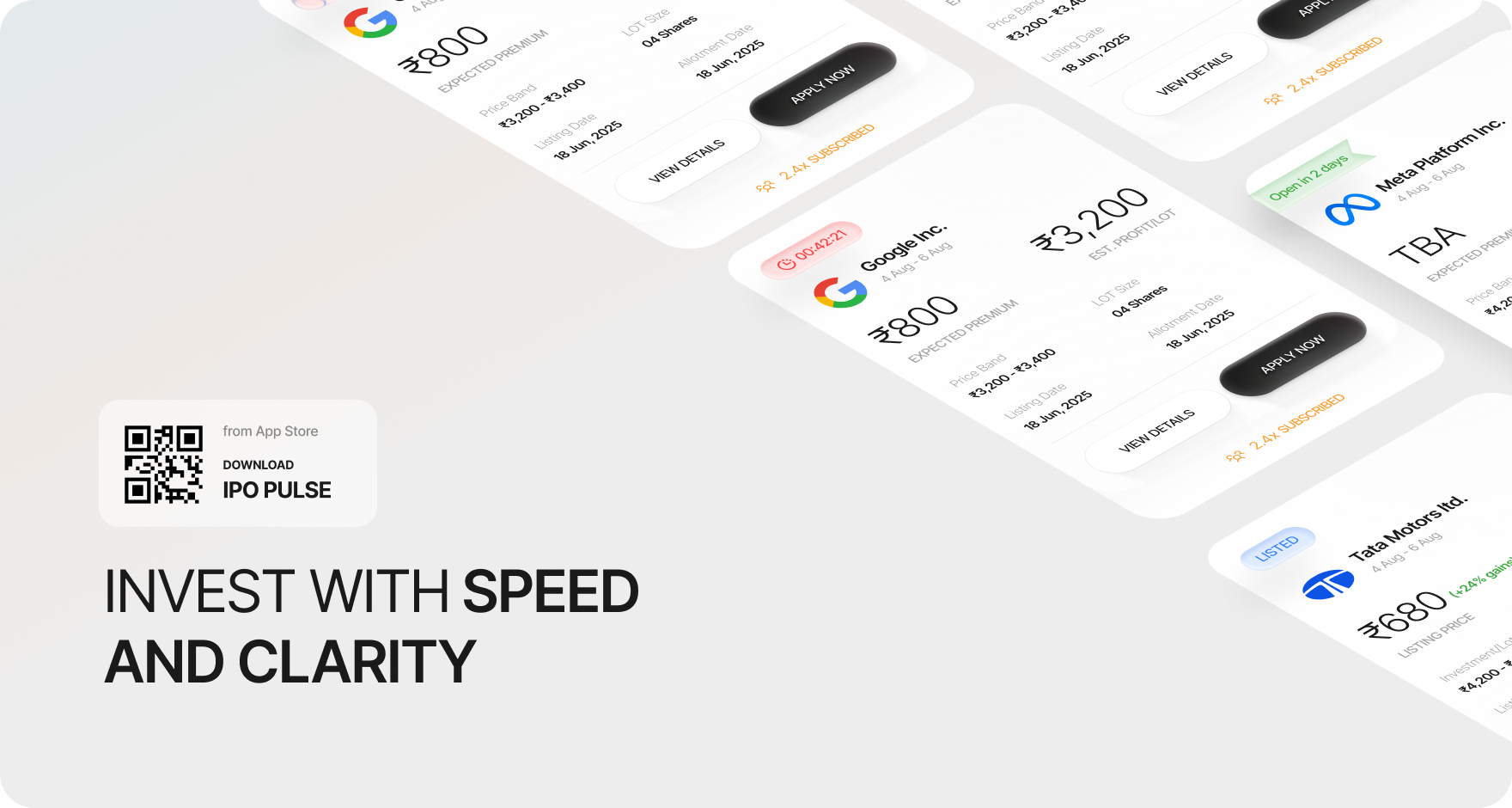
Expected Premium reflects Grey Market Premium, indicating listing sentiment.
Auto-filled details, seamless multi-demat applying, and instant order execution.
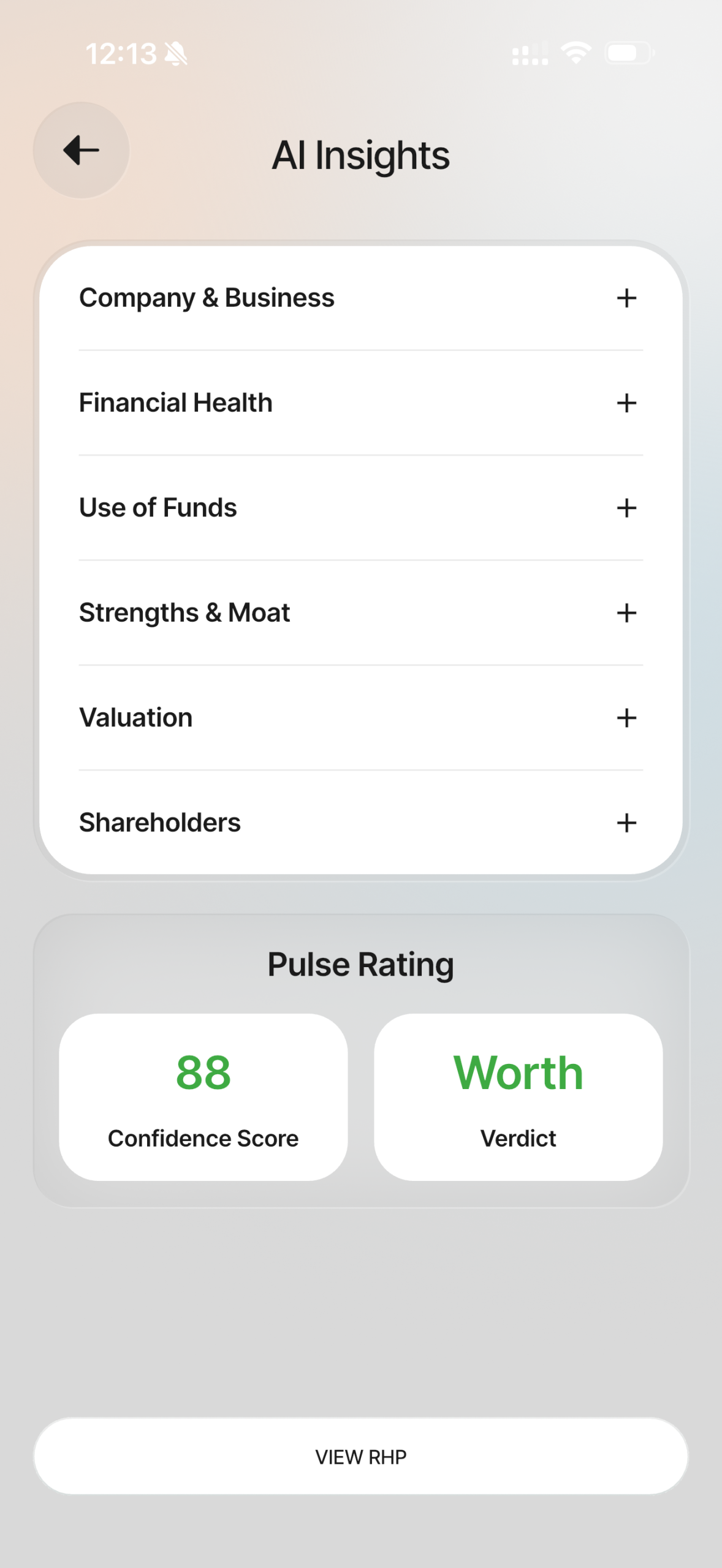
AI-powered RHP insights, real-time subscription (demand) trends, and Pulse Rating - before you apply.
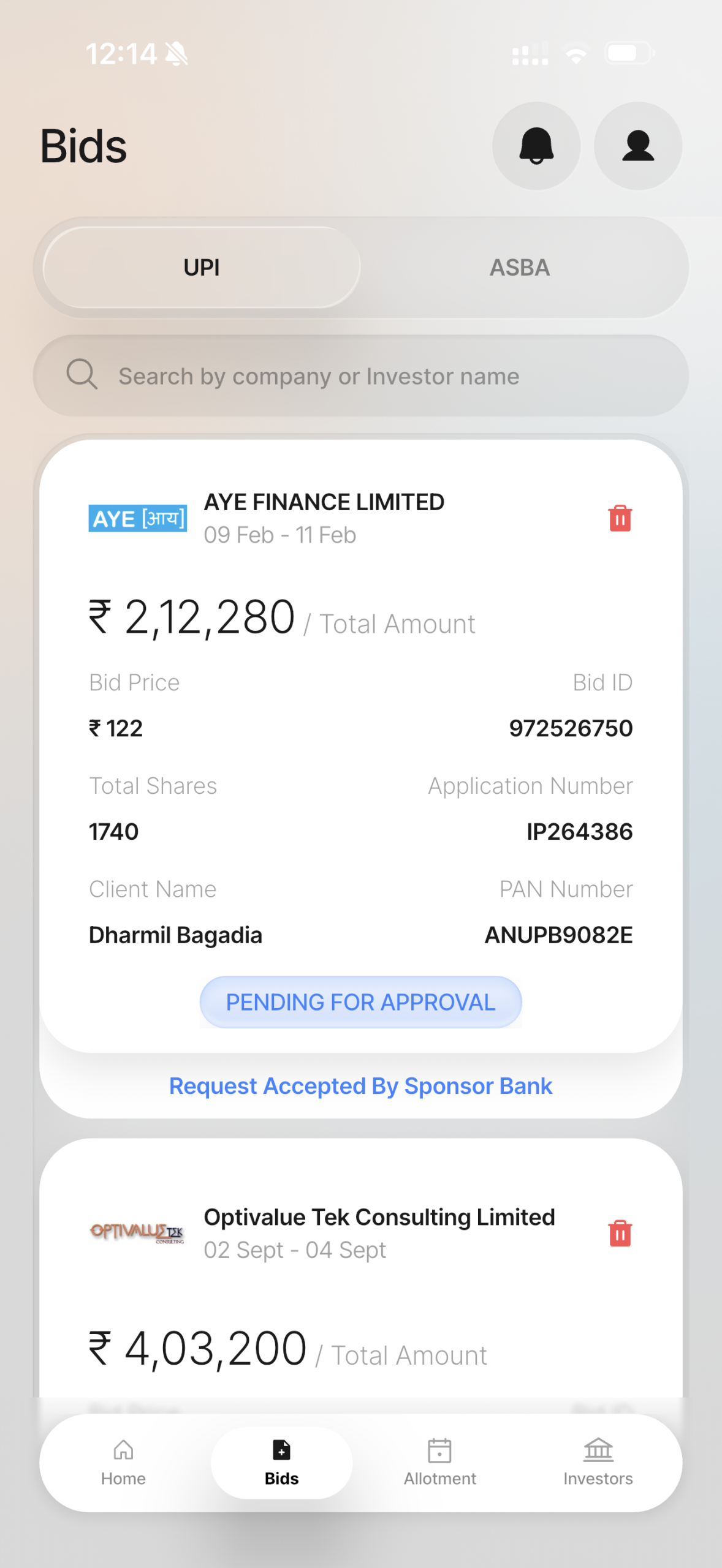
Flexible choice of UPI or ASBA on one screen, multi-demat applications, and instant access to allotment.
Browse live and upcoming IPOs with Al-powered summaries
Securely link your all your demats for easy application.
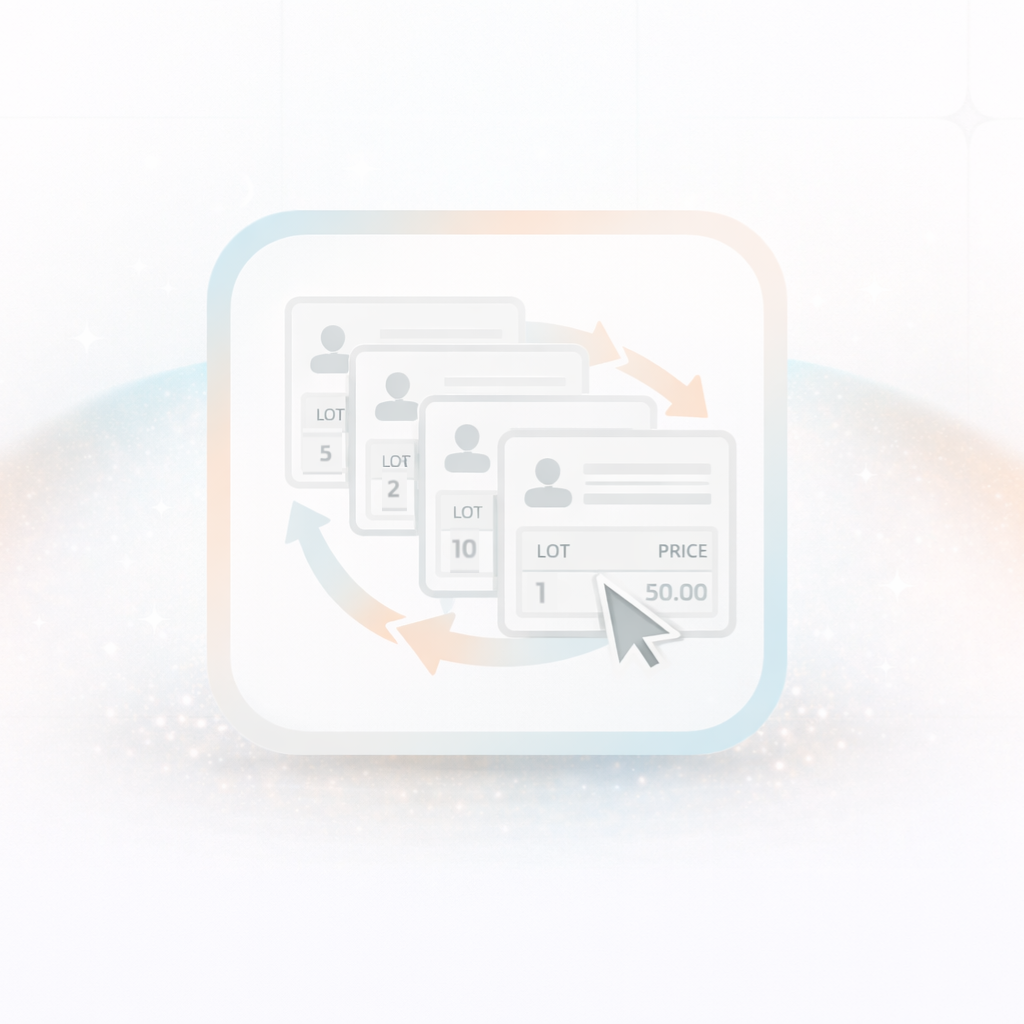
Apply for multiple demat accounts in one seamless flow.
Live subscription, Allotment status, and Listing performance.
Multi-Demat Execution
Real-time category-wise subscription trends and demand momentum.
Encrypted, tokenised, protected.
Track subscription and GMP across categories in real time. Monitor demand before locking your bid.
Al-Powered RHP Insights
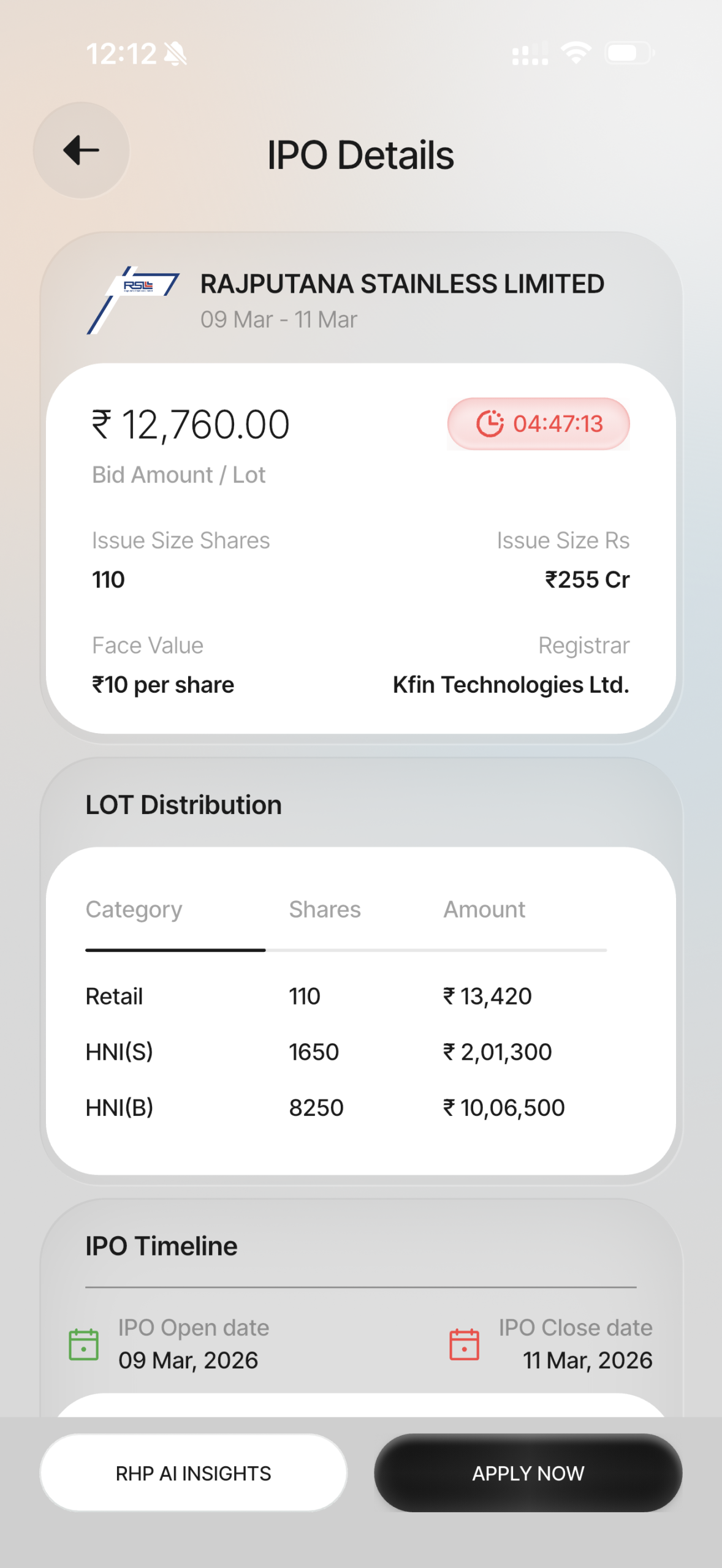
From 1000 pages to crisp, investor-focused clarity. AI summarises key metrics, strengths & risks.
Auto-populated details, fewer errors, faster submissions.
Secure encryption, tokenised payments, and two factor authentication.
Company's strengths and risks, subscription trends - All in one view.
Expected Premium reflects Grey Market Premium, indicating listing sentiment.
Auto-populated details, fewer errors, faster submissions.
Secure encryption, tokenised payments, and two factor authentication.
Company's strengths and risks, subscription trends - All in one view.
Expected Premium reflects Grey Market Premium, indicating listing sentiment.
See how IPO Pulse stacks up against generic platforms- Faster insights, Smarter tools, better control.
“Built specifically for IPO-focused investors”
Apply for multiple investors in one structured flow at once
AI summaries, key metrics & risk highlights
“Built specifically for IPO-focused investors”
To get started, create an account on the platform, explore the available IPOs, choose the one that fits your investment goals, select your preferred payment method—UPI or ASBA—and complete your application securely.Lorem ipsum dolor sit amet, consectetur adipiscing elit. Ut elit tellus, luctus nec ullamcorper mattis, pulvinar dapibus leo.
To get started, create an account on the platform, explore the available IPOs, choose the one that fits your investment goals, select your preferred payment method — UPI or ASBA and complete your application securely. Register Investors to avoid repeating to type personal information.
You need:
A PAN card
An active demat account
A bank account linked with UPI or ASBA
Sufficient funds for the IPO application
IPO Pulse helps you link and manage everything in one place
Yes, IPO regulations allow investors to apply using multiple demat accounts, provided each application has a unique PAN and bank account. Multi-demat applications increase participation flexibility but must follow SEBI guidelines to avoid rejection.
The minimum amount required to apply for an IPO depends on the lot size and price band. Retail investors must apply for at least one lot, which usually ranges between ₹12,000 and ₹15,000. IPO Pulse automatically calculates the total investment amount based on the selected lots and price.
IPO cut-off price means the investor agrees to subscribe at the final issue price determined after the book-building process. Retail investors can select the cut-off option, which increases the chances of allotment. HNI investors must place a specific price bid within the price band.
ASBA (Application Supported by Blocked Amount) blocks the IPO amount in your bank account instead of debiting it immediately. Funds remain in your account until allotment is finalized.
When applying via UPI, you receive a mandate request in your UPI app. Approving it blocks the required amount in your bank account until allotment.
Yes. IPO applications can be modified or cancelled before the IPO closes, subject to exchange guidelines.
You must select UPI or ASBA while applying. Changes can be made only before the IPO closes and subject to exchange rules.
Retail investors can apply up to ₹2 lakh.
HNI (High Net-worth Individuals) apply above ₹2 lakh.
Allotment rules and competition differ between these categories.
After the IPO closes, applications are processed based on demand and category rules. If the IPO is oversubscribed, allotment may happen through a lottery system (for Retail). Shares are credited to your demat account if allotted.
You can check allotment status through IPO Pulse or the registrar’s website by entering your PAN, application number, or demat details.
IPO subscription is calculated by dividing the total number of shares applied for by the total number of shares offered in a particular category (Retail, HNI, or QIB).
For example, if 1 crore shares are offered in the retail category and investors apply for 10 crore shares, the retail portion is said to be 10 times (10x) subscribed.
A higher subscription indicates strong demand, but it does not guarantee allotment. In oversubscribed IPOs, retail allotment is typically decided through a lottery system, while HNI and institutional allotments are proportionate.
GMP, or Grey Market Premium, refers to the informal price at which IPO shares trade in the grey market before listing. It reflects investor sentiment and perceived demand for the issue. GMP is calculated as the premium over the IPO issue price and may change daily based on demand conditions. S.
For example, if an IPO is priced at ₹100 and the GMP is ₹25, the expected listing price is estimated around ₹125. However, GMP is not regulated by SEBI and operates outside official exchanges. It should be considered only as an indicator of sentiment, not a guaranteed listing return.
**Note: At IPO Pulse, we display this as Expected Premium to provide investors with a market-based indication of potential listing sentiment. It is derived from grey market activity and helps gauge demand perception before listing.
However, Expected Premium is not guaranteed and may change depending on market conditions, subscription levels, and overall investor sentiment. It should be used as a reference indicator alongside company fundamentals, valuation, and risk factors.

IPO Pulse uses encrypted data transmission, secure payment mechanisms, and two-factor authentication. Your funds remain in your bank account under UPI/ASBA rules until allotment.
No. Under UPI and ASBA, the amount is blocked — not debited. It is deducted only if shares are allotted. If not allotted, the block is automatically released.
If you are not allotted shares, the blocked amount is released automatically in your bank account within a few working days.
If you face any issue during IPO application or tracking, you can contact customer support for assistance. Most queries related to allotment, UPI mandate, or account linking can be resolved quickly through guided support channels.
No. IPO Pulse does not hold, transfer, or manage your funds at any stage.
All payments are processed securely through regulated banking channels via UPI mandate or ASBA (Application Supported by Blocked Amount). The application amount remains blocked in your bank account and is debited only if shares are allotted.
If you do not receive allotment, the blocked amount is automatically released by your bank. IPO Pulse acts purely as an application and tracking interface, your money always remains with your bank.
IPO investments are regulated by SEBI and follow a structured process, making them transparent and legally supervised. However, like all stock market investments, IPOs carry market risk.
The share price may list at a premium, at par, or even below the issue price depending on demand, company fundamentals, and overall market conditions. Investors should review key factors such as financial performance, business model, valuation, and risk disclosures before applying.
IPO Pulse helps you evaluate these factors through AI-powered RHP insights, subscription trends, and risk summaries. So now you can make informed decisions, not emotional ones.